The Utah Housing Pulse: Rates Dip Again, but Price Still Decides the Sale
The Utah Housing Pulse: Rates Dip Again, but Price Still Decides the Sale
· @Doug
Mortgage rates eased for the second week in a row, and buyers noticed. But if you're selling, don't let a small rate dip change your strategy. This week's numbers say the same thing in several different ways: pricing against today's competition decides whether a home sells, and for how much.
Here's what's happening in our market, what the headline numbers leave out, and what it means for you.
1. Rates improved again, but the payment change is still small
Mortgage rates improved for the second week in a row. That's good news, and two weeks of movement in the same direction is worth paying attention to.
Still, keep it in perspective. When rates move by a fraction of a point, the change in a monthly payment is usually measured in tens of dollars, not hundreds. On a typical Wasatch Front purchase, that's rarely enough to change what a buyer can afford or which homes they can shop.
For buyers, that means there's no reason to rush because of one good week, and no reason to sit out waiting for a big drop that may not come. For sellers, it means a slightly better rate won't create a wave of new buyers willing to pay more than the market supports.
2. Buyers responded, so demand is still there
When rates dipped, buyer activity picked up a little. That tells us something important: there are buyers on the sidelines who are ready to move when the numbers feel right.
But activity is still well below last year. Buyers are out there, just not in the numbers that would push prices up or create bidding wars on ordinary listings. They're responsive, but they aren't in a hurry, and they have options.
3. About one-third fewer homes went under contract in Davis and Weber Counties
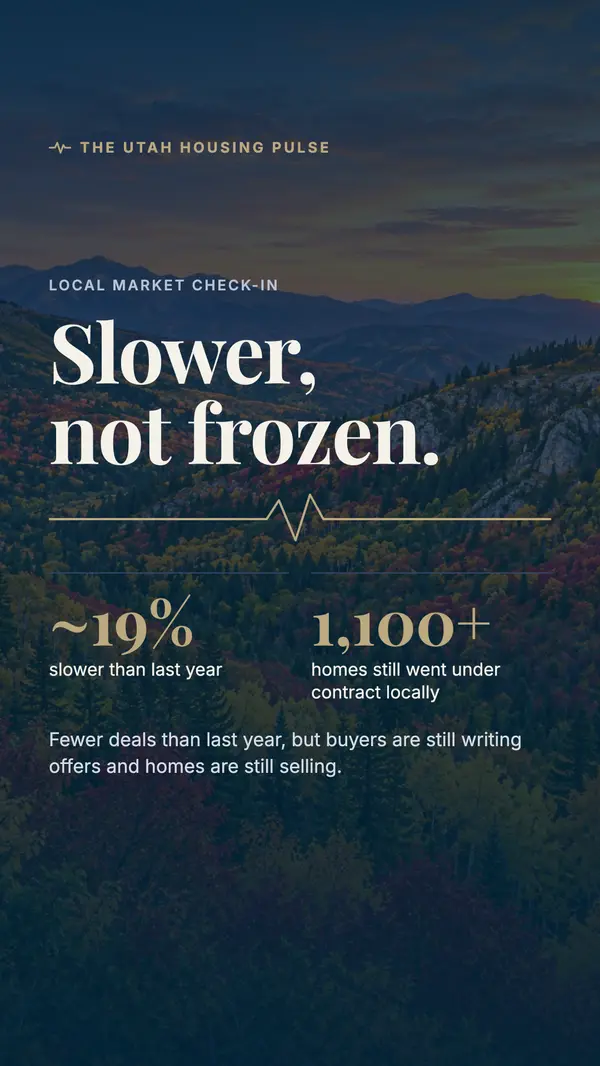
In September, about one-third fewer homes went under contract in Davis and Weber Counties than a year earlier. That's a meaningful slowdown, and it changes how a home has to be priced.
With fewer buyers writing offers, every buyer has more homes to choose from. They tour your home, then they tour the three similar homes down the street. Your price isn't judged against what a neighbor got last spring. It's judged against what's for sale right now.
That's why pricing against today's competition matters so much. The question isn't "What's my home worth?" in the abstract. It's "Why would a buyer choose my home over the others they're looking at this week?"
4. Homes are selling close to asking price, but that's not the whole story
The homes that closed sold fairly close to their asking price. On the surface, that sounds like sellers are getting what they ask for. Two things make that number less rosy than it looks.
Many sellers reduced their price first. The published sale-to-list ratio usually compares the sale price to the final list price, not the original one. A home that started too high, sat, cut its price and then sold near the new number looks like a close-to-asking sale, even though the seller lost time and money getting there.
The ratio doesn't include concessions. If a seller pays part of the buyer's closing costs, that money comes out of the seller's proceeds, but it doesn't show up in the sale price. So a home can sell at 99% of asking on paper while the seller actually nets noticeably less. That's where the next number comes in.
5. Sellers paid buyers' closing costs 62% of the time
In October, homes that sold between $500,000 and $1 million came with seller-paid concessions 62% of the time. When sellers paid, they covered an average of $13,800 of the buyer's closing costs.
In other words, concessions aren't the exception right now. In that price range, they're the norm.
Here's what that looks like on a single sale, as an example. A home sells for $650,000, and the seller pays $13,800 toward the buyer's closing costs. The public record shows a $650,000 sale. The seller's effective price is $636,200, about 2.1% less.
For buyers, this means asking for help with closing costs is a normal, reasonable request in today's market, not an insult. It can reduce the cash you need to close, or go toward buying down your interest rate.
For sellers, it means planning for concessions from the start. If you price your home expecting to net the full list price, you may be surprised at the closing table. Build a likely concession into your numbers before you list, so you know your real bottom line.
6. Don't count on lower rates to rescue an overpriced listing
A well-presented, well-priced home can still sell in this market. Clean, staged, well-photographed homes that are priced against today's competition are still getting offers.
What's risky is pricing high and hoping lower rates will bring in buyers who'll pay it. Rates have improved, but only slightly, and the payment difference is small. That isn't enough to make an overpriced home look like a good deal.
Meanwhile, every week a home sits costs the seller something: another mortgage payment, more days on market that make buyers wonder what's wrong, and less negotiating power when an offer finally comes. Too often the result is a price cut later, plus a concession, plus lost time. Pricing it right at the start usually nets more than chasing the market down.
What this means for you
If you're buying
- You have room to negotiate. With fewer homes going under contract, many sellers are open to reasonable offers.
- Ask about closing costs. Seller-paid concessions are common in the $500,000 to $1 million range right now.
- Don't wait on rates alone. Small rate moves change your payment only a little. The right home at the right price matters more.
- Get pre-approved now. When the right home comes up, you'll be ready to move while other buyers are still deciding.
If you're selling
- Price against today's competition. Buyers compare your home to what's for sale this week, not to last year's sales.
- Plan for concessions. Budget for a likely closing-cost credit so your net proceeds hold no surprises.
- Presentation still wins. Prep, staging and great photos help your home stand out to pickier buyers.
- Start at the right price. A reduction later usually costs more than pricing well from day one.
The bottom line
Rates are moving in the right direction, and buyers are responding. But with about a third fewer homes going under contract in Davis and Weber Counties, and most mid-range sellers paying toward buyers' closing costs, price and presentation are what get a home sold.
Wondering what your home would sell for, and what you'd actually net, in today's market? Get your free home evaluation, or reach out and I'll walk you through the numbers for your neighborhood.
Doug Cary, The Cary Group | Century 21 Everest
Categories
Recent Posts